Portable Power Hub: The Ultimate Guide for US Consumers
*Your comprehensive resource for understanding portable power stations in 2025*
—
What Is a Portable Power Hub?
A portable power hub—commonly called a portable power station—is a rechargeable battery-based device that stores electrical energy for use when traditional grid power is unavailable. These units typically feature multiple output ports, allowing users to power everything from smartphones and laptops to larger appliances like refrigerators and power tools [1][2].
Unlike gas-powered generators, portable power stations produce no direct emissions during operation, making them suitable for indoor use and environmentally conscious consumers [1]. The technology has evolved significantly since early patents in the late 1990s and early 2000s, which established foundational concepts for USB charging accessories and backup power supplies [2].
Modern portable power hubs serve three primary functions:
– Emergency backup power during grid outages
– Off-grid power for camping, tailgating, and outdoor recreation
– Portable energy independence for remote work or travel
—
Market Overview: Growth and Adoption Trends
Market Size and Projections
The US portable power station market demonstrates strong growth momentum. According to industry research, the market reached approximately $78.41 million in 2024 and is projected to grow to $139.72 million by 2035, reflecting a compound annual growth rate (CAGR) of approximately 5.39% from 2025 to 2035 [6]. Another report projects slightly higher growth at a 7.21% CAGR from 2024 to 2030 [3][5].
This growth is driven by several converging factors:
– Outdoor recreation expansion: Camping, hiking, and van life continue gaining popularity across the United States [3]
– Climate-related grid instability: Increased frequency of severe weather events drives demand for backup power solutions [3]
– Remote work adoption: More Americans working from mobile locations require reliable power sources
– Renewable energy integration: Consumers increasingly seek solar-compatible power solutions [3]
Regional Demand Patterns
The western United States—including California, Washington, and Colorado—holds a significant market share due to strong outdoor lifestyles and eco-conscious consumer bases [3]. These states also experience frequent wildfires, driving demand for clean backup power systems [3].
Rural areas in states like Louisiana and Alabama support consistent sales due to grid vulnerability and limited infrastructure [3]. The online distribution channel remains the fastest-growing segment, with consumers preferring platforms like Amazon and brand websites for their detailed specifications, customer reviews, and comparison tools [3][5].
—
Battery Technology: Understanding Your Options
Lithium-Ion vs. Lithium Iron Phosphate (LiFePO4)
Two primary battery chemistries dominate the portable power station market [6]:
Lithium-Ion (Li-ion) batteries offer high energy density and lighter weight, making them popular for applications where portability is paramount. Industry research confirms that lithium-ion technology was adopted earlier in the market timeline [1].
Lithium Iron Phosphate (LiFePO4) batteries—like those found in the Anker SOLIX F3000—provide superior cycle life and enhanced thermal stability [4]. Industry sources confirm that LiFePO4 adoption has increased as the technology has matured [1].
Cycle Life and Battery Health
Cycle life represents how many complete charge/discharge cycles a battery can undergo before capacity degrades significantly. Higher-quality units now offer 4,000+ cycles while maintaining 80% of original capacity [4]. This represents a significant improvement over earlier generations and makes modern units more economical over extended use periods.
Practical Limitation: Actual cycle life varies based on usage patterns, temperature exposure, and charging practices. Users should verify specific warranty terms and cycle ratings for individual products.
—
Key Specifications Explained
When evaluating portable power stations, these specifications matter most:
| Specification | What It Means | Why It Matters |
|—————-|—————|—————-|
| Capacity (Wh) | Total energy storage | Determines how long you can power devices |
| Output Power (W) | Maximum instantaneous power | Limits which appliances you can run |
| AC Output | Standard wall outlet power | Required for most household devices |
| USB-C/USB-A | Device charging ports | Powers phones, laptops, tablets |
| Solar Input | Renewable charging capability | Enables off-grid independence |
| UPS Function | Uninterruptible power switchover | Critical for sensitive electronics |
| Charge Time | Time to fully recharge | Affects usability and convenience |
The Trade-off Between Capacity and Portability
Higher capacity units generally weigh more and cost more. A 3,072Wh unit like the Anker SOLIX F3000 weighs approximately 91.5 pounds with wheels installed [4]. Smaller units (under 500Wh) offer greater portability but limited runtime for larger appliances [6].
Recommendation: Assess your actual power needs before purchasing. Consider the heaviest draw device you'll need to power and calculate required capacity accordingly.
—
Major Brands and Market Players
The US portable power station market is consolidated, with established brands dominating the landscape [3][5]:
– Goal Zero
– Jackery
– EcoFlow
– Anker
– Bluetti
Other notable players include Duracell, Klein Tools, ChargeTech, Honda Power Equipment, Oukitel, Rockpals, Lion Energy, and Schneider Electric [5].
Brand Selection Considerations
Recommendation: Stick with established brands that offer:
– Clear warranty terms (look for 2-5 year warranties) [4]
– Accessible customer support
– Readily available replacement parts and accessories
– Verified safety certifications
*Smaller or lesser-known brands may offer lower prices but could present risks regarding quality control, safety standards, and long-term support. Readers should independently verify any brand's reputation before purchase.*
—
Practical Applications and Use Cases
Emergency Power Preparedness
Portable power stations serve as valuable emergency resources during grid outages caused by storms, heat waves, or other disasters [1]. FEMA disaster preparedness reports inform industry understanding of consumer needs in this category [1].
Recommended minimum capacity for emergency use: 1,000-2,000Wh to power essential devices (refrigerator, phone charging, lighting, communication devices) for 24-48 hours.
Outdoor Recreation
For camping and tailgating, capacity needs depend on your power requirements and trip duration. Solar-compatible units enable multi-day off-grid adventures without seeking grid power [4].
Practical Limitation: Solar charging times vary significantly based on panel wattage, sunlight conditions, and angle. Under optimal conditions, some units can achieve solar recharge times of approximately 1.25-2.5 hours at higher input levels, but real-world performance often falls short of these figures [4]. Readers should verify solar performance claims with independent reviews.
Remote Work and Digital Nomadism
Powering a laptop (50-100W), monitor, and Wi-Fi router requires relatively modest capacity—a 500-1,000Wh unit typically suffices for a full workday.
—
How to Choose the Right Portable Power Station
Step 1: Assess Your Power Needs
1. List all devices you'll power
2. Note each device's wattage (found on labels or documentation)
3. Estimate hours of use per day
4. Calculate total daily watt-hour requirement
Step 2: Match Capacity and Output
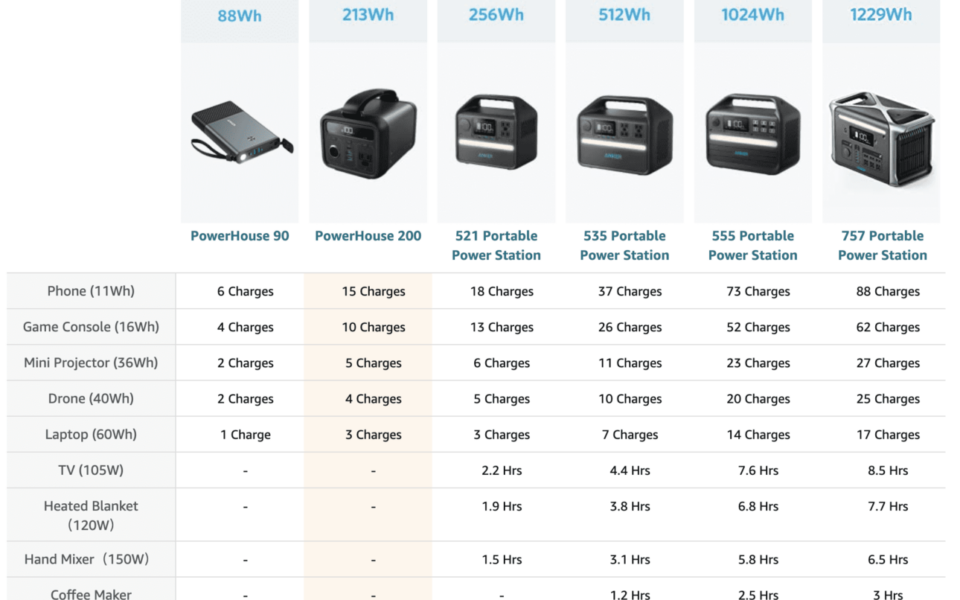
– Under 500Wh: Light use—phones, tablets, laptops, small devices
– 500-999Wh: Moderate use—adds small appliances, short appliance runtime
– 1,000-1,499Wh: Extended use—refrigerators, power tools, multiple devices
– 1,500Wh+: Heavy use—full home backup, multiple large appliances, professional equipment [6]
Step 3: Evaluate Charging Options
– AC (wall outlet) charging: Fastest option; 1-2 hours for premium units [4]
– Solar charging: Essential for off-grid use; verify compatibility and maximum input ratings
– Car charging: Useful during travel; typically slower than AC
Step 4: Consider Future Expansion
Some units offer expandable capacity through additional battery modules. The Anker SOLIX F3000, for example, supports adding up to three extra batteries for a total capacity of 12,288Wh [4]. This modularity can extend product lifespan as your needs evolve.
—
Safety Considerations and Standards
The portable power station industry operates under multiple safety frameworks:
– IEEE standards (including IEEE 1547 and IEEE 2030 family) provide technical guidelines for energy storage systems [1]
– NEMA standards establish energy storage specifications [1]
– CPSC battery safety databases track product safety issues [1]
– EPA emission standards address environmental considerations [1]
Recommended safety practices:
– Never expose units to extreme temperatures outside their operating range (typically 32°F to 104°F for charging) [4]
– Use only manufacturer-approved accessories and cables
– Verify units carry appropriate certifications for your use case
– Store in dry, temperate conditions when not in use
—
Limitations and Things to Consider
While portable power stations offer tremendous utility, consumers should understand their constraints:
1. Runtime limitations: Even large-capacity units cannot replace full grid power indefinitely. High-draw appliances deplete capacity quickly.
2. Solar dependence for true independence: Achieving complete off-grid capability requires substantial solar panel investment and favorable weather conditions.
3. Weight and transport: Units above 1,500Wh become difficult to transport without wheels or assistance [4].
4. Capacity degradation: Battery capacity naturally decreases over time and with use, despite high cycle ratings.
5. Initial cost: Quality units with substantial capacity require significant upfront investment.
6. Limited third-party validation: Many specifications and performance claims come from manufacturers. Readers should seek independent reviews and testing data before purchasing.
—
Looking Ahead: Future Developments
Industry research indicates that smart technology integration continues reshaping the portable power station landscape [5]. Expected advancements include:
– Enhanced app-based monitoring and control
– Improved energy management algorithms
– Better integration with home electrical systems
– Faster charging technologies
– Expanded capacity in lighter packages
The convergence of renewable energy adoption, grid instability concerns, and outdoor recreation trends suggests continued market expansion through 2035 [3][6].
—
Conclusion
Portable power hubs have evolved from niche outdoor equipment into versatile energy solutions serving emergency preparedness, outdoor recreation, and mobile work needs. The market offers options across capacity ranges, battery technologies, and price points, with established brands providing reliable choices for US consumers.
Key takeaways:
– Define your power needs before purchasing
– Consider battery chemistry (LiFePO4 offers longer cycle life)
– Verify specifications through independent sources
– Plan for charging infrastructure (solar, grid, or both)
– Invest in safety-certified products from reputable manufacturers
As the US market continues growing at projected rates of 5-7% annually, consumers can expect more choices, better technology, and increasing integration between portable power stations and home energy systems.
—
Sources
[1] Market Research Future – Portable Power Station Market Size and Forecast 2035
[2] Google Patents – US8527782B2 Power Hub
[3] ResearchAndMarkets.com – U.S. Portable Power Station Research Report 2025-2030
[4] PowerGen USA – Anker SOLIX F3000 Product Page
[5] Yahoo Finance – U.S. Portable Power Station Market Research Report 2025-2030
[6] Market Research Future – US Portable Power Station Market Growth & Trends Outlook 2035
—
*This guide provides informational content based on available market research and industry sources. Specifications, prices, and availability may vary. Readers should verify current product details directly with manufacturers or retailers before making purchasing decisions.*