Decoding Capacity and Wattage in Portable Power Hubs
When shopping for a portable power hub, two numbers dominate the specification sheet: capacity and wattage. Confusing these two metrics often leads to purchasing a unit that either drains prematurely or simply cannot start your intended appliances. Understanding exactly what each number represents, how they interact, and what to verify before purchasing will help you match the right equipment to your actual power requirements.
What Capacity Actually Measures
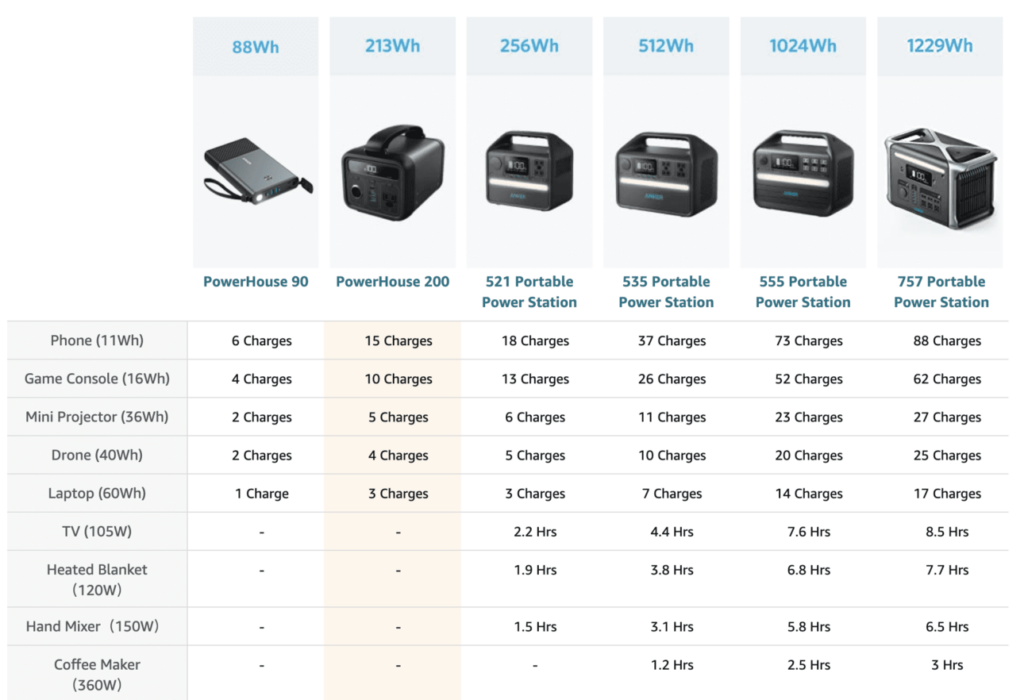
Capacity refers to the total amount of energy a portable power hub can store. It is measured in watt-hours (Wh) or kilowatt-hours (kWh) [3], [6]. This metric tells you how much power the station can supply over a given length of time [6]. For example, a battery rated at 1,000 Wh can deliver 100 watts continuously for ten hours, or 1,000 watts for one hour [6]. A higher capacity directly translates to more stored energy, which extends runtime for connected devices [6]. When evaluating capacity, buyers should also examine the battery chemistry, as different chemistries affect how consistently that stored energy is delivered across hundreds of charge cycles [2].
What Wattage Tells You About Performance
Wattage (measured in watts, or W) indicates the rate at which the power hub delivers energy at any given moment [1], [5]. While capacity measures total storage, wattage measures output speed and maximum load handling [5]. A power station might feature a massive battery but fail to run high-wattage appliances if its continuous output rating is too low [5]. Most units list a rated AC output wattage, which represents the steady power available for sustained use [3]. Additionally, manufacturers specify surge power, which reflects short-term maximum capacity essential for devices that require a high initial energy draw to start up [1], [2]. If your appliance draws more power at startup than during normal operation, the station’s surge rating must exceed that initial spike [1].
The Relationship Between Energy Storage and Power Delivery
Capacity and wattage work together, but neither guarantees performance on its own. Always check both specifications because a 2,000 Wh station with only a 300 W output rating could not power a 1,000 W microwave [5]. Conversely, a high-wattage station with a small battery will deplete rapidly under heavy loads [4]. Matching the station’s output rating with your device’s continuous and startup requirements prevents unexpected shutdowns, while aligning the watt-hour capacity with your desired runtime avoids unnecessary bulk and cost [1].\n
When powering smaller gadgets like wireless earbuds, smartwatches, or fitness trackers, these accessories typically draw minimal power under 10 W, meaning almost any portable charger or hub can handle them [4]. However, larger laptops or gaming models may require 100 W or more, which only higher-end hubs can reliably deliver [4]. A common misconception is that any high-capacity power bank or hub can fast-charge all devices efficiently; a large unit with low output wattage will charge laptops painfully slowly or not at all because most modern laptops require at least 30 W to begin charging effectively [4].
Calculating Your Real-World Power Requirements
Determining the correct balance between capacity and wattage starts with calculating your actual energy consumption. Multiply each device’s average wattage by the number of hours you plan to run it, then add those figures together to get your total watt-hour requirement [3]. After summing your needs, account for conversion losses by applying a reasonable reserve; industry planning assumptions typically factor in approximately 90 percent conversion efficiency [3]. Small trips or weekend camping excursions may require less than 300 Wh, while home-essential backup scenarios commonly benefit from 1,000 Wh or more [3].
When applying the 90 percent conversion-efficiency planning assumption, divide your total calculated watt-hours by 0.9 to determine the minimum battery capacity required [3]. For instance, if your devices consume 500 Wh combined, selecting a hub with at least 556 Wh ensures sustainable runtime without triggering low-voltage cutoffs [3]. This buffer accounts for internal inverter losses, cable resistance, and gradual battery depletion curves that occur during sustained discharge [3].
For users relying on USB-C ports, prioritize output wattage alongside capacity. A 20,000 mAh power bank with only 12 W output will struggle with modern laptops, whereas a 30,000 mAh unit with a 10 W output still charges slower than a smaller 10,000 mAh unit delivering 60 W [4]. Higher wattage transfers energy faster, which naturally depletes the battery quicker per charge cycle, so always prioritize output wattage when powering laptops or fast-charging phones [4]. Note that some hubs have multiple USB-C ports, but only one port may support high wattage simultaneously [4].
Critical Output Specifications Beyond Watts and Wh
Rating capacity and wattage correctly requires examining additional electrical specifications that dictate real-world compatibility. Standard U.S. household plug-in appliances expect 120 V at 60 Hz [3]. Some equipment depends on correct AC frequency, and incompatible voltage can cause malfunctions [3]. More importantly, the waveform type matters significantly; pure sine wave output provides better general compatibility with modern electronics and motor-driven equipment compared to modified sine wave alternatives [3].\n
Buyers should not assume a high wattage rating means whole-home compatibility [3]. An electric dryer, central air conditioner, well pump, electric range, or other hardwired 240 V loads may remain incompatible with a portable 120 V station even when the listed wattage appears mathematically sufficient [3]. Many portable stations are strictly 120 V only and cannot directly operate normal 240 V household circuits [3]. If your backup scenario includes 240 V equipment, verify separate 240 V support capabilities rather than relying solely on wattage comparisons [3].
Battery Chemistry, Maintenance, and Recharging
The internal battery chemistry heavily influences how long your hub maintains its rated capacity and how safely it operates. Lithium Iron Phosphate (LFP) batteries offer stable performance, high cycle life, and thermal stability that reduces overheating risks, making them particularly reliable for consistent watt-hour delivery over many recharge cycles [2]. These characteristics enhance overall safety, allowing confident use in varied environments [2].\n
To preserve battery lifecycle, regularly monitor charge levels and keep the unit charged between 20 percent and 80 percent while avoiding deep discharges [1]. Recharge time determines how quickly your station returns to operational status and depends on the charger wattage, battery capacity, and input limits [1], [2]. LFP batteries typically charge faster and more safely than older chemistries [2]. When integrating solar panels, aim for panel wattage matching roughly 20 to 30 percent of your station’s battery capacity in watt-hours to ensure efficient recharging without overwhelming input limits [5]. Improper solar pairing can lead to slow recharge times or equipment damage [5]. Every hub has specific solar input voltage and current limits that must be matched to your panel configuration [3], [5].
Operating conditions also influence real-world performance. Altitude, ambient temperature, and battery age can affect how accurately a station delivers its rated wattage and capacity [5]. Manufacturers typically publish operating temperature ranges that must be respected to maintain output consistency [3]. If you plan to use the hub in extreme cold or heat, verify the specified operating temperature window and allow the unit to acclimate to indoor temperatures before drawing heavy loads [3]. Proper ventilation and avoiding direct sunlight during extended discharge cycles help maintain stable voltage delivery and protect internal circuitry [3].
Verifying Specifications Before Purchase
Selecting the right portable power hub requires cross-referencing your calculated watt-hour needs with the station’s continuous and surge wattage ratings, while also verifying waveform, voltage support, and charging inputs [3]. Because manufacturer specifications, pricing, stock levels, warranty terms, and accessory compatibility frequently change based on production updates and retailer inventory, you must verify the current manufacturer or retailer listing before finalizing a purchase. Do not rely on archived comparison pages or outdated snapshots when confirming output capabilities or safety certifications. Always confirm that the unit meets your exact voltage, frequency, and pure sine wave requirements, and ensure the surge rating comfortably exceeds your highest-draw appliance startup needs [1], [3]. By systematically matching capacity, wattage, and output specifications to your documented power requirements, you can select a portable power hub that delivers reliable, safe performance without overspending on unnecessary capacity or risking equipment damage from mismatched electrical demands.
Sources
[1] https://deadsetlive.com/travel-camping/portable-power-station-specs-explained
[2] https://deadsetlive.com?p=1845
[3] https://udpwr.com/blogs/news/what-parameters-should-be-considered-when-purchasing-a-portable-power-station
[4] https://www.alibaba.com/product-insights/portable-charger-wattage-explained-what-you-actually-need-on-the-go.html
[5] https://batteryskills.com/what-is-a-good-wattage-for-a-portable-power-station
[6] https://www.baseus.com/blogs/content/what-is-a-portable-power-station-and-how-do-you-choose-the-best