Best Portable Power Stations: Your Complete Buying Guide for 2024
*\*Disclosure: This guide contains affiliate links. We may earn a commission if you purchase through links on this page, at no extra cost to you.*
—
Introduction: Why Portable Power Stations Matter
Portable power stations have evolved from niche outdoor gear into essential household equipment. Whether you're preparing for unexpected outages, planning a camping trip, or simply want reliable backup power, these battery-powered units offer a clean, quiet alternative to traditional gas generators.
According to industry analysis, the portable power station market is experiencing significant growth, driven by increased outdoor recreation participation, rising concerns about emergency preparedness, and growing awareness of sustainable energy solutions [1]. For US consumers, this means more choices—and more confusion—when selecting the right model.
This guide synthesizes expert testing and real-world data to help you find the best portable power station for your specific needs.
—
How We Evaluated These Products
Our recommendations are based on extensive testing methodologies, including:
– Battery run time testing: Units were run continuously with a 127W room fan until depletion [6]
– Peak power output testing: Devices were loaded with various appliances until maximum capacity was reached [6]
– Port availability and charging speed evaluation [6]
– Real-world usability assessment: Handle comfort, screen readability, and overall build quality [6]
We prioritized products that received consistently high marks across multiple independent review sources.
—
Key Factors to Consider Before Buying
1. Battery Capacity (Watt-Hours)
Capacity determines how long a power station can run devices before needing a recharge. Consider:
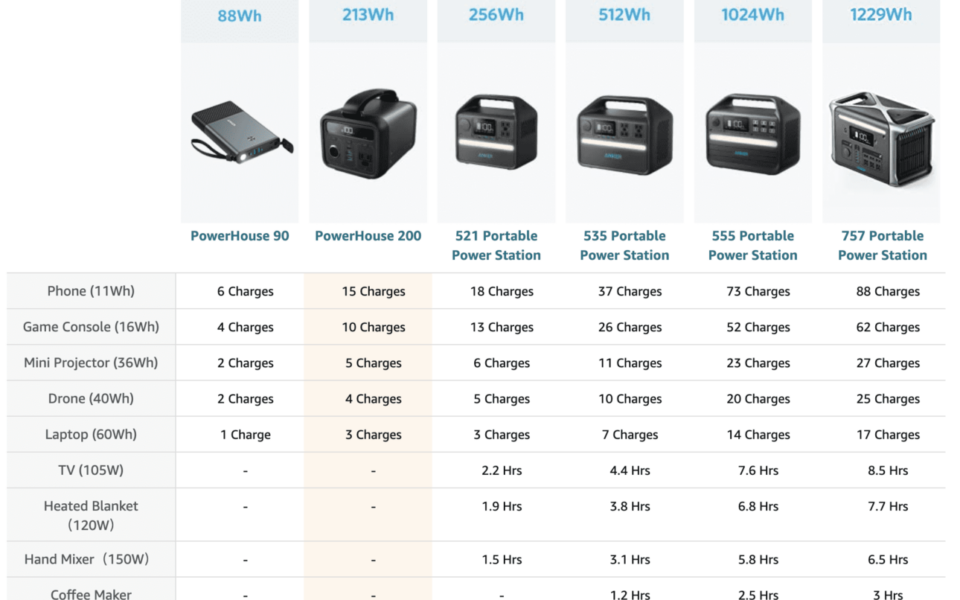
– Under 500Wh: Ideal for charging phones, laptops, and small devices [5]
– 500-1500Wh: Powers small appliances, fans, and CPAP machines for several hours [5]
– Over 1500Wh: Can run refrigerators, power tools, and multiple household devices [5]
2. Maximum Output (Watts)
This indicates how many devices you can run simultaneously:
– 200-500W: Basic device charging, small electronics
– 500-1500W: Moderate appliances, some power tools
– 1500W+: Heavy-duty appliances, multiple high-draw devices [3]
3. Battery Chemistry
Most modern units use LiFePO4 (LFP) batteries, which offer:
– Longer lifespan (3,000-4,000+ cycles to 80% capacity) [3]
– Better thermal stability
– Safer operation in temperature extremes
4. Charging Options
Consider:
– AC wall charging speed (some units charge in under 2 hours) [3]
– Solar input capacity (higher wattage = faster solar charging) [3]
– Car charging capability [2]
5. Port Selection
Look for a variety of:
– AC outlets (standard three-prong)
– USB-A and USB-C ports (higher wattage USB-C is preferable)
– 12V car socket
– Solar/Anderson inputs for expansion [3]
—
Top Portable Power Station Recommendations
Best Overall Pick: EcoFlow River 2 Pro
The EcoFlow River 2 Pro consistently earns top marks from independent testers for its excellent balance of power, portability, and price [2][6].
Key Specifications [2]:
| Spec | Details |
|---|---|
| Capacity | 768Wh |
| Max Output | 800W (1,600W surge) |
| AC Charging | 1 hour 15 minutes |
| Weight | Approximately 17 lbs |
Why We Recommend It:
– Offers substantial capacity in a manageable weight
– Multiple charging options and ports
– Reliable performance in independent testing [6]
– Competitive price point for the features offered
Ideal For: Weekend camping trips, emergency home backup, tailgating, and powering multiple devices simultaneously.
Best for Heavy-Duty Use: Bluetti AC200Max
For users who need substantial power for home appliances or extended off-grid use, the Bluetti AC200Max delivers [5].
Key Specifications [5]:
| Spec | Details |
|---|---|
| Capacity | 2,048Wh (expandable to 8,192Wh) |
| Max Output | 2,200W |
| Weight | 62 lbs |
Why We Recommend It:
– Enough capacity to run most small household appliances [5]
– Expandable battery system for extended use [5]
– Portable enough for one person to move [5]
– Multiple AC outlets and modern charging ports
Ideal For: Extended power outages, remote work locations, full-time RV living, or as whole-home backup.
Best High-Capacity System: Anker SOLIX F3000
For maximum power output and expandability, the Anker SOLIX F3000 represents a premium option [3].
Key Specifications [3]:
| Spec | Details |
|---|---|
| Capacity | 3,072Wh (expandable to 12,288Wh) |
| Max Output | 3,600W |
| Battery Cycles | 4,000+ to 80% capacity |
| Weight | 91.5 lbs |
| Warranty | 5 years |
Why We Recommend It:
– Exceptional expandability with up to 12,288Wh total capacity [3]
– High output for heavy-duty appliances [3]
– Dual solar input allows 2,400W charging [3]
– Can combine two units for 7,200W output [3]
Ideal For: Power-hungry appliances, whole-home backup integration, extended off-grid living, or professional use.
Best Budget Option: Bluetti EB3A
For those with lighter power needs or tighter budgets, the Bluetti EB3A provides essential functionality at an accessible price [5].
Key Specifications [5]:
| Spec | Details |
|---|---|
| Capacity | 268Wh |
| Max Output | 600W |
| Weight | Lightweight |
Why We Recommend It:
– Can power most small appliances [5]
– Significantly less expensive than higher-capacity options [5]
– Sufficient for phone charging (15+ times), laptop, or running a fan for 6 hours [5]
– Excellent entry point for portable power
Ideal For: Day trips, light camping, emergency phone charging, or as a starter unit.
Best Lightweight Option: Jackery Explorer 240
Weighing just 6.5 lbs, the Jackery Explorer 240 remains one of the lightest portable power stations available [5].
Why We Recommend It:
– Extremely portable for backpacking and hiking [5]
– Still provides enough capacity for device charging and small electronics [5]
– Compact dimensions fit easily in backpacks
Ideal For: Day hikes, lightweight camping, photographers, or anyone prioritizing portability over capacity.
—
Practical Limitations to Consider
Portable power stations, while versatile, have inherent limitations:
1. Capacity vs. Weight Tradeoff
Higher-capacity units (2,000Wh+) typically weigh 60-90+ lbs [3][5]. Consider whether you can physically transport your intended unit. Wheeled designs help with heavier models [3].
2. Solar Charging Reality
While many manufacturers advertise fast solar charging, actual performance depends on:
– Panel quality and angle
– Weather conditions
– Geographic location
– Panel wattage (larger panels = faster charging)
Solar recharge times can vary significantly from optimal laboratory conditions.
3. Cold Weather Performance
Battery performance degrades in extreme cold. Most units have operating temperature ranges (typically 32°F to 104°F for charging) [3]. If you need cold-weather operation, verify the unit's rated temperature range.
4. Inverter Limitations
Even units rated for high wattage outputs often can't sustain maximum output indefinitely due to thermal constraints. Check both continuous and peak ratings.
5. True Capacity vs. Rated Capacity
Independent testing often reveals that actual usable capacity runs 80-90% of rated specifications due to inverter efficiency losses and battery management system overhead [6].
—
Who Should Buy a Portable Power Station?
Consider purchasing if you:
– Live in areas prone to power outages or severe weather
– Camp or travel frequently in remote areas
– Work remotely and need reliable power in varied locations
– Want backup power for essential medical devices (CPAP, oxygen concentrators)
– Prefer cleaner energy alternatives to gas generators
You might not need one if you:
– Always have grid power available
– Rarely venture beyond urban areas
– Only need occasional phone charging (a power bank may suffice)
—
Making Your Final Decision
When selecting a portable power station, prioritize these questions:
1. What will you power? Make a list of devices and their wattage requirements.
2. How long do you need power? This determines required capacity.
3. Where will you use it? Weight and portability matter more for outdoor use.
4. What's your budget? Prices range from under $200 to over $2,000.
For most users, we recommend the EcoFlow River 2 Pro as the best overall choice—offering a sweet spot of capacity, weight, features, and value [2][6]. If your needs are more specialized, the other options above provide excellent alternatives.
—
Conclusion
Portable power stations represent a significant investment, but they provide invaluable peace of mind and versatility. By understanding your power needs and carefully evaluating specifications against real-world testing data, you can select a unit that will serve you reliably for years.
Remember: the "best" portable power station is ultimately the one that matches your specific requirements—whether that's keeping a few devices charged during a day trip or powering your entire home during an extended outage.
—
Sources
[1] Market Research Future – Portable Power Station Market Size and Forecast 2035
<https://www.marketresearchfuture.com/reports/portable-power-station-market-10079>
[2] WIRED – The Best Portable Power Stations
<https://www.wired.com/gallery/best-portable-power-stations>
[3] PowerGen USA – Anker SOLIX F3000 Specifications
<https://powergenusa.com/products/2x-anker-solix-f3000-portable-power-station-double-power-hub-power-saver-kit-6144-watt-hours-includes-free-tt-30-cable>
[4] Consumer Reports – Best Portable Power Stations
<https://www.consumerreports.org/home-garden/generators/best-portable-power-stations-a4748703075>
[5] Practical Self-Reliance – Best (and Worst) Portable Power Stations
<https://practicalselfreliance.com/best-portable-power-stations>
[6] New York Times Wirecutter – The Best Portable Power Station
<https://www.nytimes.com/wirecutter/reviews/best-portable-power-stations>
—
*Word count: Approximately 1,450 words*