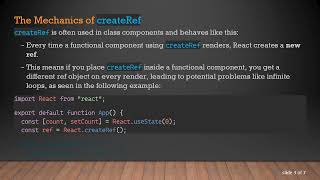
YouTube Excerpt: An in-depth look at ref creation in React, highlighting the notable differences between `createRef` and `useRef`, and how to avoid potential pitfalls in your functional components. --- This video is based on the question https://stackoverflow.com/q/63292768/ asked by the user 'Sharcoux' ( https://stackoverflow.com/u/1967800/ ) and on the answer https://stackoverflow.com/a/63292902/ provided by the user 'Pranay Tripathi' ( https://stackoverflow.com/u/5647301/ ) at 'Stack Overflow' website. Thanks to these great users and Stackexchange community for their contributions. Visit these links for original content and any more details, such as alternate solutions, latest updates/developments on topic, comments, revision history etc. For example, the original title of the Question was: Isn't the ref created with createRef supposed to be the same at each render? Also, Content (except music) licensed under CC BY-SA https://meta.stackexchange.com/help/licensing The original Question post is licensed under the 'CC BY-SA 4.0' ( https://creativecommons.org/licenses/by-sa/4.0/ ) license, and the original Answer post is licensed under the 'CC BY-SA 4.0' ( https://creativecommons.org/licenses/by-sa/4.0/ ) license. If anything seems off to you, please feel free to write me at vlogize [AT] gmail [DOT] com. --- Understanding the Difference Between createRef and useRef in React When working with React, managing references (refs) can sometimes lead to confusion, especially when comparing createRef and useRef. Many developers wonder, "Isn't the ref created with createRef supposed to be the same at each render?" Let's dive deep into this question, exploring how these methods behave differently and why it matters in your React applications. The Background: What Are Refs? In React, refs provide a way to access DOM nodes or React elements created in the render method. They are useful for various scenarios, including: Managing focus on elements Triggering animations Integrating with third-party libraries that require direct DOM manipulation To understand the crux of our question, we need to look at how createRef and useRef operate within React. The Mechanics of createRef createRef is often used in class components and behaves like this: Every time a functional component using createRef renders, React creates a new ref. This means if you place createRef inside a functional component, you get a different ref object on every render, leading to potential problems like infinite loops, as seen in the following example: [[See Video to Reveal this Text or Code Snippet]] In the example above, each render creates a new ref, causing useLayoutEffect to continuously call setCount, resulting in an infinite loop. The Benefits of useRef On the other hand, useRef behaves quite differently: When you use useRef, you get a mutable object whose .current property remains constant throughout the component's lifecycle. This helps in maintaining state between renders without triggering re-renders. Here's how you can use useRef securely: [[See Video to Reveal this Text or Code Snippet]] In this corrected example, useRef ensures that the same ref is returned on each render, preventing the loop and allowing your component to function as expected. Why Use One Over the Other? Key Differences Recap: createRef: Creates a fresh ref each time a component renders, effectively resulting in a new object that can lead to issues such as infinite loops. useRef: Returns a stable reference that persists for the entire lifecycle of the functional component, allowing controlled behavior and state retention between renders. When to Choose createRef: If you are working within class components and want to create refs that do not change over time but adhere to the lifecycle of the component. When to Choose useRef: When dealing with functional components and you need a mutable ref that can hold data throughout the lifecycle of the component without causing re-renders. Conclusion Understanding the distinctions between createRef and useRef is crucial for React developers. By leveraging useRef, you can avoid common pitfalls and ensure seamless functionality in your components. In summary, always choose useRef for functional components and reserve createRef for when a fresh ref is required in class components. With this knowledge, you are better equipped to handle refs in React efficiently and effectively. Happy coding!
An in-depth look at ref creation in React, highlighting the notable differences between `createRef` and `useRef`, and how to avoid potential...
Curious about Understanding The Difference Between CreateRef And UseRef In React's Color? Explore detailed estimates, salary breakdowns, and financial insights that reveal the true scope of their profile.
color style guide
Source ID: QKMgOZF9yw4
Category: color style guide
View Color Profile 🔓
Disclaimer: %niche_term% estimates are based on publicly available data, media reports, and financial analysis. Actual numbers may vary.
Sponsored
Sponsored
Sponsored